



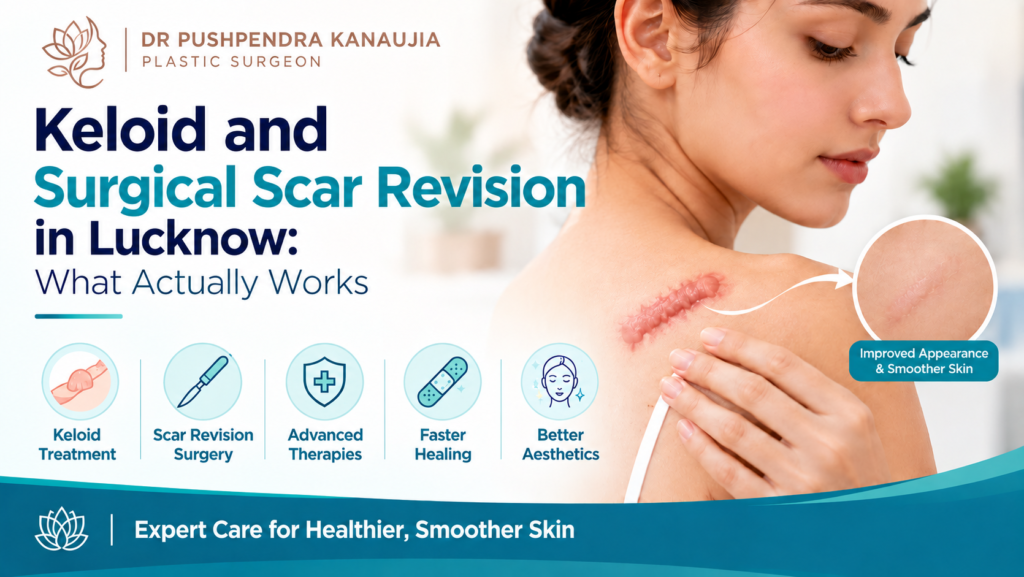
Looking for keloid treatment in Lucknow? Scars are unavoidable whenever skin is cut or burned, but some scars go far beyond what is expected. They grow larger than the original wound and become raised, hard, itchy, or darkly pigmented. For patients living with keloids, hypertrophic scars, or wide surgical scars, the emotional and physical burden is significant.
I want to address this topic in depth because scar management is one of the most nuanced areas of plastic surgery, and one where misinformation (and false promises) are most common. At Dr. Pushpendra Kanaujia’s clinic, we take a structured, evidence-based approach to every scar, because no two scars are the same.
Types of Problematic Scars
Keloid Scars
A keloid is a scar that grows beyond the original wound boundary. It results from overproduction of collagen during healing and is more common in darker skin tones and in certain body areas: earlobes, chest, shoulders, and upper back. Keloids can continue growing for years and often itch or cause pain. They do not resolve on their own.
Hypertrophic Scars
Unlike keloids, hypertrophic scars remain within the wound boundary but become raised and thickened. They are more common after burns or incisions under tension. Many hypertrophic scars improve with time and conservative treatment.
Widened or Atrophic Scars
Some scars flatten and widen – common after abdominal surgery or C-sections – or become depressed (atrophic), as seen in post-inflammatory scarring after chickenpox or deep infections.
Treatment Options: What Works and What Doesn’t
| Treatment | Best For | Limitations |
|---|---|---|
| Corticosteroid injections | Keloids, hypertrophic scars | Temporary; often needs repeat sessions |
| Silicone sheets/gel | New hypertrophic scars | Takes 3–6 months; less effective for keloids |
| Laser therapy (CO₂ / Nd:YAG) | Colour, texture, surface irregularity | Does not remove raised scars |
| Surgical excision | Wide/atrophic scars, selected keloids | Risk of recurrence; must combine with adjuncts |
| Intralesional 5-FU | Resistant keloids | Requires multiple sessions |
| Pressure therapy | Burn hypertrophic scars | Must be worn 23 hrs/day |
| Radiotherapy post-excision | High-recurrence keloids | Requires radiation facility |
The Key Principle in Keloid Management
No single treatment cures keloids permanently. The gold standard is combined therapy — usually surgical excision followed immediately by corticosteroid injection, silicone dressings, and sometimes low-dose radiotherapy. Any surgeon who promises a keloid will not come back after a single treatment is overpromising. I always explain this clearly to my patients before we begin, because managing expectations is part of the treatment.
A consultation with Dr. Kanaujia will determine the most appropriate combination approach for your specific scar type, location, and skin tone.
When Is Surgery Needed for Scar Revision?
Our scar revision surgery is recommended in the following situations:
- Functionally restrictive scars — pulling joints or restricting movement (contractures)
- Very wide or spread surgical scars that can be re-excised and closed under less tension
- C-section or abdominoplasty scars that are mispositioned or uneven
- Scars that have not responded to 6–12 months of conservative treatment
In these cases, surgery is not the first resort — it is the right resort. A consultation will help determine whether you have reached that threshold.
A Word of Caution About Topical Creams
The Indian market is flooded with scar creams — many of which are simply moisturisers with minor onion extract or allantoin. While some silicone-based gels have genuine evidence, most over-the-counter scar creams will not flatten a true keloid. Please consult a plastic surgeon before spending months on products that will not help a raised scar.
Get a Scar Assessment
Every scar has a different cause, behaviour, and ideal treatment path. Dr. Pushpendra Kanaujia offers a detailed scar evaluation to determine the most effective treatment combination for your specific condition — without guesswork or one-size-fits-all protocols.
A consultation with Dr. Kanaujia will determine the most appropriate treatment for your condition. Learn more about our scar revision surgery or visit here to explore all services.
